

OILS FOR PREGNANCY, BABIES AND BEYOND
If you’ve landed on this page, chances are you’re discovering the powerful ways in which doTERRA oils and products can support a healthy lifestyle if you have little ones in your house
(or, at least, you’re curious about how they can support you!)
Maybe you’re a little nervous to use oils on your kids; maybe you’re not sure if they’re entirely safe for the younger set.
As an essential oil user and mama to two amazing kids, let me tell you that doTERRA’s products can be powerful tools to use with your children.
We enjoy them daily in our house. If these products are used with care and common sense, you can safely reap all the benefits they have to offer.
Let this space serve as a guide that empowers you to use nature’s medicine to support your health and wellbeing.
Here is a great collection of blogs written by doTERRA

PREGNANCY, BIRTH, + POSTPARTUM
Essential Oils During Pregnancy
By Ashley Glassman, Real Essential Oils Education
Using herbs and essential oils during your pregnancy can be extremely helpful, especially considering that many traditional over the counter medicines become off limits. Essential oils can be used very safely and effectively for relaxation, pain relief, digestive upsets, cramps, and other discomforts. The opinions are somewhat varied on which essential should be used during pregnancy, and there may be more oils that are safe and effective to use during pregnancy than I have listed here. I base my information and recommendations on the advice from various safety experts, midwives, and vintage aromatherapists, as well as my own personal experience and knowledge of the chemistry of each oil and how they actually affect the body and hormones. Some of the discrepancy in information available is due to the fact that very few actual studies have focused on large groups of women during pregnancy. This is partly due to the fact that natural substances generally are not widely used for blind test groups, and also because pregnant women from around the globe aren’t exactly lining up to be included in experiments! And who can blame them? So again, while there may be many more oils that are safe for use during pregnancy, I have only listed the ones I know to be safe from experience and other experts’ opinions. It is important, as always, to make sure you are using high quality oils when you are pregnant, for the health of both you and your baby.
Despite the varied opinions on certain essential oils, there are some oils that universally should be avoided during pregnancy. The most common reasons for avoiding certain oils during pregnancy are due to hormonal effects, and to the stimulating effects on the uterus, which can cause contractions. Now it is important to note, that just because an oil can affect the hormones, doesn’t mean that it is estrogenic, it simply means it can have an impact on the hormones, and should be avoided during pregnancy. Also, certain oils are known to increase blood pressure, affect kidney function, and cause extra skin sensitivity during pregnancy. If a book or person cannot explain to you WHY an oil is or is not safe during pregnancy, I would not base your decisions on what they have to say. Sadly, even many very well educated aromatherapists advise blanket avoiding of oils that could be used very successfully and safely, simply because they do not wish to take the time to truly teach the ins and outs of safety, and any possible contradictions.
Some oils that should be always be avoided during pregnancy are: nutmeg, rosemary, basil, jasmine, clary sage, juniper, sage, laurel, angelica, thyme, citronella, and cinnamon. Because of the slight hormonal effects of lavender, rose, and tea tree, it is sometimes suggested that these oils be avoided during the first trimester, but they may be safely used from the beginning of the second trimester on. Also, peppermint should be used topically with caution, as it can cause irritation to the skin during pregnancy, and should be avoided shortly before birth, because it can decrease milk supply. It is also technically possible that peppermint could cause some uterine cramping, although actual cases of this aren’t actually documented, but avoiding it during the first trimester is recommended to stay on the safe side. Menthol can have a negative effect on infants, and the affects of the oil for unborn babies when topically applied to the skin is not well studied. For this reason some aromatherapists advocate avoiding peppermint completely during pregnancy. In my experience, using peppermint aromatically after the first trimester, for short term applications such as for a migraine can be very safe, and effective. There are no cases showing peppermint oil to have harmed mother or baby during pregnancy, but there are certainly some situations where any peppermint oil during pregnancy would be contraindicated. But for normal, healthy pregnancies, peppermint can be useful in some situations. Clary sage is also an oil that has some controversy surrounding it during pregnancy. At a minimum, avoiding it during the first trimester is a good idea, in fact, avoiding all essential oils during your first trimester is generally recommended. This doesn’t mean there aren’t situations where some oils could be safely and effectively used, it simply means there are reasons for caution.
In my personal experience 90% of the time whole herbs, or other herbal preparations can be used far more safely and effectively for most situations during pregnancy than essential oils can. Again, that is not to say there isn’t a place for them, but often when people find out how limited the amount of essential oils are that are safe for pregnancy, they feel their “natural” options for managing unwanted symptoms are gone too. But this is not the case at all! Symptoms such as heart burn, nausea, muscle aches, etc., can often be dealt with using herbal preparations that are far less concentrated and far safer for both mama and baby during pregnancy. So don’t despair just because an essential oil is on the “no” list, you may be able to use the plant itself very effectively.
If your pregnancy has suffered from complications, it may be wise for you to do a bit more research into which oils are safe for your specific needs, and discuss using them with your doctor or midwife. However, if your pregnancy is normal and healthy, essential oils can be used very effectively for a variety of ailments.
Here are some different categories of common discomforts associated with pregnancy, and some oils that are safe and may be helpful to use.
Relaxation and Anti-Stress: Bergamot, Frankincense, Lavender, Patchouli, Chamomile, Wild Orange, Tangerine
Pain And Tension Relief: Cypress, Frankincense, Lavender (after the first trimester), Chamomile, Peppermint (sparingly at the beginning of pregnancy because of it’s possible stimulating properties, and sparingly at the end of pregnancy, as peppermint can decrease milk production)
Digestive Health: Ginger, Peppermint (sparingly at the end of pregnancy as it can decrease milk production), Spearmint, Lemon, Grapefruit, Lime
Skin Health (and stretch marks): Frankincense, Lavender (after the first trimester), Rose (after the first trimester), Sandalwood, Myrrh, Chamomile, Tea Tree (after the first trimester)
A great ways to utilize essential oils during pregnancy is to add a few drops mixed with Epsom salt for use as a bath salt soak. The magnesium in the Epsom salt helps with relaxation and aids circulation as well. Using a few drops of oil in a footbath is another great way to absorb the oils, while easing the pain of tired feet. Placing a few drops of essential oil in some carrier oil and using it as a massage oil for tight or irritated skin is also helpful. And making a mixture of some of the oils that aid in digestion, and rubbing the diluted mixture over the digestive tract is yet another suggestion.
The oils listed above are oils that have been used and tested on hundreds of women by various midwives without negative results or side effects. This being said, if in doubt, check with your doctor or other professionals to see if using these oils is right for you, and always be sure you are using the oil correctly diluted, and in a safe manner.
Helpful tips and remedies from midwife
Stephanie Fritz
She has a wonderful book (Essential oils for Pregnancy, Birth & Babies) and a helpful Facebook Page
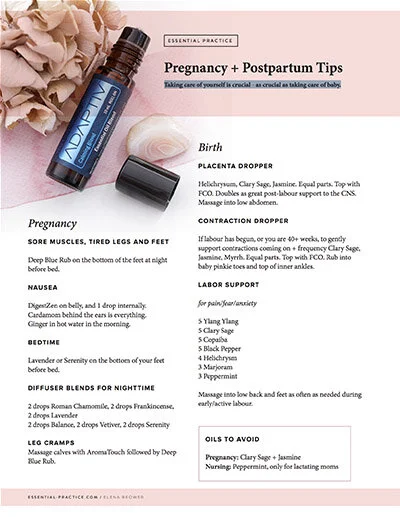
Pregnancy
Morning sickness: Put three drops of grapefruit or peppermint essential oil into a diffuser by your bed. This can sometimes help with the morning nausea. You may find that waking up to these aromas helps
Swelling and water retention and Pregnancy Edema: Lemon- use a few drops in water internally on a daily basis. “Liquid Sunshine”, super antioxidant and antibacterial properties. You can also use three drops of Geranium, Ginger, Lemon and Lavender in a roller bottle with fractionated coconut oil and roll on ankles and feet a few times a day especially at the end of the day and massage feet and ankles in a upward movement toward the heart. Place a drop of each over your ❤
Heartburn & morning sickness: DigestZen and/or Peppermint a drop under the tongue, rubbed on abdomen, a few drops in a capsule a couple times a day, or rubbed on the bottoms of your feet. You can also fold a tissue into a small square or cup your hands and add 3 drops of peppermint essential oil. Inhale as needed for either. Another option is: If you can tolerate it, add three drops of peppermint essential oil in a glass of water and sip throughout the day.
Restful Sleep and/or insomnia: Serenity especially nearing delivery
Low Back & Leg Pain & Pressure: Deep Blue & AromaTouch nightly massage is wonderful!
Sciatica: Mix 3 drops of essential oil with 1 tbs carrier oil and apply to the painful location. Rubbing a few drops of geranium on the painful location & then soak in a bath of epsom salts w/ lavender.
Congestion: Add a few drops of Breathe to your diffuser, cup of your hands or bowl of hot water and inhale steam. Place a drop of clove and thyme on the tips of your middle finger and fingerwalk middle of the nose up and out towards the cheek bones.
Depression: Place 3 drops of Lavender or Elevation and mix it with a carrier oil. Then massage it into upper back, neck and face and avoiding eyes. Wear as a perfume or diffuse Citrus Bliss.
Avoiding Stretch Marks: Add 2-3 drops of each Helichrysum, Lavender, Frankincense, 1 cup Virgin Olive Oil, and liquid from 6 capsules Vitamin E and 4 capsules Vitamin A. Apply a couple times a day starting when you feel like it.
Emotional Stress: Add 2 drops of either Lavender or Elevation to a carrier oil & massage into wrists, neck and around ears.
Gas (flatulence): Mix 1 drop of peppermint in 1 tsp. of honey. Stir into a small glass of warm water.
Group Beta Strep: Mix 3 drops of OnGuard + 3 drops of Oregano on soles of feet am/pm
Hemorrhoids: Mix 3 drops Aromatouch and 5 drops geranium to 1 tbsp. carrier oil and apply to the area with hemorrhoids or you can do this and then soak in a sitz bath.
High Blood Pressure: Put 3 drops of ylang ylang to 2 tbsp of bath salts and mix with bath water. Bathe in the evening 2x week.
Toxemia: Mix 2 drops cypress oil to 2 tsp. of carrier oil. Massage into abdomen and bottoms of feet.
Insomnia: Put 3 drops of either lavender or ylang ylang to 1 tbsp carrier oil and do a full body massage. Diffuse either of these oils in the air. You can also spritz your pillow with Serenity.
Yeast Infection: Mix 3 drops of melaleuca and 1 drop lavender with 2 tbsp of bath salts. Add to warm water and soak for 10 min.
Labor
Pre-term labor: Lavender and Serenity. Mix 3 drops of lavender into a carrier oil more and massage from the legs from the ankles up toward the heart.
Breech baby: Mix 5 drops of Myrrh w 1 tbsp. of carrier oil. Massage abdomen in a circular motion ending with visualizing the baby head down.
Induction and speed up slow labor: Clary Sage- it is a uterine tonic. Place a drop on ankle reflex points.
To calm and focus Mom: Use Balance. You can diffuse or just open the bottle for smelling
Energy for and during labor: Peppermint topically, in water, or diffused.
Labor room or area: Diffuse 5-7 drops of either Serenity or Elevation into the air with a diffuser to improve the over all calmness, peacefulness and happiness in the room.
Back Labor: Use a few drops of Peppermint and/or Deep Blue and massage back and apply pressure. This will relieve some of the discomfort especially with a posterior baby.
Labor pains: You can use lavender and/or clary sage and put in with 2 tablespoons of bath salts and soak in bath. Mix 2 drops of balance in 1 tbsp of carrier oil and massage hips, bottoms of feet and abdomen. Or use a warm compress and apply 2 drops of whisper or ylang ylang and place the wet cloth on the abdomen or back as desired.
Perspiration (Excess): Add 2-3 drops of lavender to a bowl of slightly warm water. Dip a washcloth into the bowl and wipe off excess perspiration. This will also CALM the mother down as well.
Hyperventilation: You can use 1-2 drops of any of these essential oils (ylang ylang,geranium,wild orange or breathe and place it on a tissue or cup your hands and have mom inhale.
Anxiety: Add 2 drops of any of these oils ( lavender, wild orange, serenity) in a bowl of cool water. Soak a washcloth in the water, wring it out and use it to mop the face as desired.
To avoid or minimize tearing: Mix 5 drops of clary sage and 2 drops of geranium with 2 tbsp or carrier oil massage hourly into the perineal area. If mother has torn, you can mix a few drops of Helichrysum and place it on a warm compress on the perineal area. If hemorrhaging, seek medical attention immediately. Have mother take an 00 capsule of helichrysym oil internally.
Uterine massage: Mix 5 drops of lavender, 7 drops of whisper with 2 ó tbsp or carrier oil and massage abdomen until uterus is well contracted and firm.
Reflexology Points: Precautions ~ The following pressure points should not be accessed before you reach your 40th week. Always check with your doctor or midwife before doing anything to stimulate contractions. Pressure points may feel tender, but it should not hurt you. If you feel pain, reduce pressure and make sure you have the right spot! If a contraction starts, stop the pressure and wait until the contraction ends. Then you can apply pressure again.
Thumb Point: Press firmly on the center of your thumb for a few minutes, then switch to the other thumb. This is one of the most effective points used in reflexology for inducing labor. It stimulates the pituitary gland to release oxytocin, one of the main hormones that causes the uterus to contract.
Arch of Foot : This point is located inside the arch of the foot, just in front of the heel. Apply firm pressure, but not so hard that it causes pain. This point is also very helpful in relieving intense pain during childbirth.Inside
Heel: Apply pressure to the point just inside the heel of the foot, aligned with your ankle. If it feels tender you’ve found the right spot.Between Toes : Apply pressure one finger’s-length below the point between the big toe and the second toe. This point will also be tender when you find it.
Acupressure Points:
Webbing between your thumb and forefinger: Press or massage the top of this webbing. This point affects the large intestine which surrounds a portion of the uterus, stimulating contractions.
Shoulder muscle: Press and massage the highest point of your shoulder muscle.Inside ankle. Find the point four finger’s-width above the inside of your ankle. Apply pressure; it helps ripen the cervix and strengthen weak contractions.
Outside ankle: To help the baby descend toward the pelvis, put pressure on the point between your ankle bone (outer ankle) and Achilles tendon (which runs up the back of your leg)
Lower back: This point is actually located one finger’s-width above your buttocks crease. Feel for a small indentation and massage for a minute.
Roof of Mouth: Using your tongue, press on the roof of your mouth with your tongue as far back as you can. This is a handy one you can use as you go about your daily routine.
From Robert Tisserand: New research confirms that Lavender oil helps in labor pain.
A recently published study investigated the effect of Lavender inhalation on the severity of labor pain and duration of labor. The Lavender group inhaled diluted essential oil for three minutes at three different labor stages, and experienced a significant drop in pain levels. For example 9.6 to 7.6 at 9-10 cm dilation after the intervention. There was no effect on the duration of labor, suggesting that Lavender oil does not affect labor progression.
https://www.ncbi.nlm.nih.gov/pubmed/27863615
This is consistent with the findings of a 2000 study by Ethel Burns et al, where 344 mother used Lavender oil during childbirth and 54% reported reduced pain levels, though these were not graded. No adverse effects were reported.
https://www.ncbi.nlm.nih.gov/pubmed/11033651
A 2014 study in Tehran used Orange flower hydrosol (control group used saline). In the control group, pain increased from 7.5 (minimal dilation) to 9.5 (8-10 cm dilation) while in the aromatherapy group the increase in pain rating was marginal - from 7.4 to 7.6.
https://www.ncbi.nlm.nih.gov/pmc/articles/PMC4177623/pdf/ijpr-13-1011.pdf
Postpartum-Mom
After birth bleeding: Clary Sage, Helichrysum, and Ylang Ylang this tones things back up quickly. Place mix on ankle reflex points.
Pain and inflammation: Lavender and Frankincense on frozen feminine pads for soothing, healing, and inflammation for immediately after the birth
Cramping & Abdominal Pain: Deep blue (along with acetaminophen and ibuprofen for the first 48 hours)rubbed directly on lower abdomen
Hemorrhoids: Cypress, Geranium, Clary Sage, Helichrysum- 1-2 drops of each in a spray bottle base of Fractionated oil for Hemorrhoids. Apply each time you use the restroom.
Nipple Soreness: Helichrysum & Lavender for breastfeeding soreness (brings healing and elasticity- cut down soreness to 2 days vs. 10-14 days)
Dried or cracked nipples: Mix 5 drops of any of these oils (geranium, myrrh, sandlewood or balance) with 1 tbsp carrier oil. Clean oils off before nursing.
Engorgement: Add 2 drops of lavender oil and 2 drops of geranium to one cup hot or cold water. Soak a washcloth in the solution, wring out and apply washcloth to breasts. After try to gently express some milk.
Lactation:
Increase: Mix 5-7 drops of any of these oils (fennel, basil, clary sage or geranium) with 1 tbsp carrier oil. Massage breasts, lymph area above breasts and upper back along the spine. Repeat daily for up to 10 days. Wash the oil off the nipple area before nursing. Also you can mix 2 drops fennel oil with 1 tsp. of honey and swallow. Follow this with a glass of water. Repeat 3-5 times daily for up to 3 days.
Decrease:Mix 3-4 drops of peppermint with 1 c. cold water. Soak washcloth in the mixture, wring it out and apply to breasts. Wash the nipple off before nursing.
Perineal Healing: Mix 2 drops of cypress and 2 drops of lavender with ó tsp.of bath salts. Add to warm sitz bath and soak for 10-15 min. Repeat up to 3x a day.
Yeast infection: avoid and kill-Melaleuca in the squirt bottle when urinating. Mix with Fractionated coconut oil for Diaper rash.
Post Partum Depression: Disperse 5-7 drops of essential oils in the diffuser 3x a day ( either citrus bliss, elevation, clary sage or bergamot). Mix 6 drops of either orange, geranium, elevation or frankincense with 1 tbsp of carrier oil and massage neck, shoulders and feet. Repeat up to 3 times daily.

Essential Oils For Babies and Children
By Ashley Glassman, Real Essential Oils Education
Herbs and essential oils have played a huge part for me in raising my son and my younger sister, and also in creating the line of baby skincare products that I sell in my store and online. Essential oils can be extremely helpful for such common occurrences as diaper rash, cradle cap, ear infection, and colic. The most important rule when using essential oils on babies is ALWAYS DILUTE more than you think you should. Whether using an essential oil topically, or with a diffuser, never use an oil straight, or neat. Always, always dilute. Babies skin and mucous membranes are much more sensitive than ours are as adults, and care should be taken so as not to cause any irritation. We want these oils to help and soothe, not cause additional irritation! A 0.5 5 – 1% dilution can work wonders. Stronger is often not better, especially when using essential oils for young children. Remember these essential oils are extremely powerful, and one drop can equal many pounds of the plan itself, so don’t fall for the thinking that you need more to help your problem.
A good rule of thumb for dilution is: For infants, 2 drops of essential oil to 2 tablespoons of a carrier oil. For children over one year, you may increase to 4 drops of essential oil to 2 tablespoons of carrier oil. For diffusing, mix 1 tablespoon of water with 1 drop of essential oil and add to your diffuser. Some essential oils do not require this much dilution, but it is a good rule of thumb unless you are certain that the essential oil you are using requires less dilution and will not cause irritation. And in my opinion, there is never a reason for an infant or toddler to use an essential oil without dilution.
It is also important to remember that babies senses are very heightened. What may seem mild and pleasant to you may be very irritating and strong to your baby. So always avoid placing oils anywhere near the face of a small infant, even if diluted. Apply any topical oils to an infants back if the situation you are in does not require an oil be applied to a specific location. (ie. a bite or sting where you would want to put the oil on the place the child was stung.)
For infants, very few oils should be used. Again, just as with pregnancy, often times whole herb preparations such as infused oils are far safer, and more effective for treating rashes etc. Chamomile, lavender, sandalwood etc, can be safely used in an extremely diluted (0.25% or less) solution for some short term ailments such as a diaper rash. You may read some people advocating putting lavender oil undiluted, or even 50/50 on an infant every night to help them sleep. This is NOT advised. Essential oils should never be used for anything more than a very temporary issue on children under the age of 2. And even after the age of 2, daily use of the same oil can cause sensitization that can last into adulthood and require them to avoid a particular oil for the rest of their life. So when looking for solutions for ailments for children under 2, always explore whole herb options first. Infused oils, teas, glycerites etc., and if you decide to use an essential oil, only do so for a short period of time, and very, very well diluted.
Here are some different categories and some of the essential oils that have been very helpful for me when working with children. Again, always remember to NEVER apply an oil directly to to an infants skin. Typically, making a soothing salve, with one or more of these oils is the most effective.
Cradle Cap: Chamomile, Lavender, Sandalwood, Rose, Patchouli, Geranium
Respiratory Infections and Colds: Lavender, Peppermint (not for infants), Spearmint (not for infants), Basil (not for infants) Tea Tree
Diaper Rash: Chamomile, Lavender, Patchouli, Rose, Frankincense, Myrrh
Ear Infections and Ear Pain: Lavender, Clove (not for infants), Tea Tree, Frankincense
Colic and Digestive Issues: Fennel (not for infants), Peppermint (not for infants), Spearmint (not for infants), Lavender, Chamomile
This is by no means an all-inclusive list of oils that can be helpful, but these are some of my favorite go-to oils for infants and toddlers. There is no way in one short lesson that I can cover all of the material, recipes, ideas, or safety information for using essential oils during pregnancy, and for use on babies and children. My goal today is not to give you ALL the information you need, but rather to introduce you to the concept, and give you some ideas for ways that essential oils might be helpful during pregnancy, and for use with children. Oils you use will change depending on what stage you are during pregnancy, and how old your children are, etc. Always do your research before using oils, only you know your health history, your child’s medical history, or any other variables that would effect your choices
Helpful tips and remedies from midwife
Stephanie Fritz
Umbilical Cord: Myrrh serves as a liquid band-aid, (avoids infection & cord fell off in 3 days vs. 7-9 days)
Birth trauma relief: Balance along the spine and bottoms of baby’s feet-“Chiropractor in a bottle”
Thrush (in mouth): Mix 1 drop of melaluca, 1 drop of lavender and 2 drops of vit E oil with 1 tsp garlic oil. Apply 1 drop of this mixture to mother’s nipples before nursing.
Calming: Frankincense and lavender on the bottoms of the feet.
Colic: Mix 1 drop of any of these essential oils ( citrus bliss, wild orange and/or lavender) with 1 tbsp carrier oil. Apply a small amount on the stomach and back. Use a warm compress to keep babies abdomen warm. Burp baby as baby needs if gas pains seem to exist.
Crying: Diffuse a few drops of Serenity or Lavender in the room where infant is.
Fever: Mix 1 drop of lavender to 1 tbsp of carrier oil apply to the bottoms of the feet, the back of the neck and behind the ears.
Diaper Rash (yeast): Mix 1 drop of melaluca with 1 tbsp of plain yogurt and apply to the bottom area (avoid genital area)Other diaper rash: mix 1 drop or lavender and 1 drop of roman chamomile with 2 tbsp of carrier oil. Avoid the genital area and change diaper frequently.
Resources:
This book is highly recommended: Essential OIls for Pregnancy, Birth & Babies
CLICK HERE to read the article below…
Lavender + Breast Buds - hmmm: http://roberttisserand.com/2013/02/lavender-oil-is-not-estrogenic/
Natural Baby Care with Nadine Artemis
Plants and flowers brim with vigorous, ever renewing life, and they symbiotically lend their life energy to sustain us. The life force of the plants oils in aromatherapy make them natural and wise attendants to births and babies. Following a few simple guidelines and your own intuition, essential oils will bless your birthing rite and befriend your new little one.
Before you put anything on yourself or your baby, you want to know that it is pure and really real. Essential oils available in the market, even those sold in health food stores, are often of questionable quality. Mass distilled for the food, flavor and perfume industry, these oils are cheaply produced, further adulterated in labs and may even be imitations. Issues with safety and effectiveness make it inadvisable to use low quality essential oils. Only authentic oils, distilled carefully and truthfully from organically grown plant matter, can fulfill the promises of plant wisdom.
Labor and Delivery
Essential oils are natural and reliable helpers as you prepare yourself and your home for your new arrival.
A few drops of Tea Tree oil, a potent botanical biotic, in warm water can keep you and your baby’s world clean, starting with the birthing pool. You can also make a spray of water and Tea Tree to wipe down high chairs, car seats, crib railings and baby toys.
When labor begins, use an essential oil diffuser to fill the air of your birthing space with an aroma that creates a calming and welcoming atmosphere. Neroli, bergamot, grapefruit, lavender, white fir and cape chamomile are lovely… and I really like frankincense for this. As a sacred oil and a portal oil, frankincense opens us during transition periods and welcomes us to new places and stages of life.
The essential oil of marjoram is an excellent choice to melt stiff and knotting muscles during labor. As I was delivering our baby, Ron, my partner, massaged a 10% dilution of marjoram and lavender in jojoba oil on to my back right in the pelvic region in rhythmic circles. It was amazing!
Let Bath Time Wait
The first few precious moments after birth is a time of celebration and bonding with your baby. Try to let this moment last for hours! It is common for medical staff to whisk away the newborn for a quick bath. Washing a baby’s skin immediately after birth is unnecessary and perhaps even counterproductive. Bathing lowers the baby’s already falling body temperature, and infants have a very limited ability to create their own body heat in the first few hours of life. Neonatal experts urge us to let the bath time wait; “Washing a baby soon after birth clearly contributes to a fall in body temperature, and for this reason it is difficult to justify this practice.” Instead, let your baby rest on your belly under a warm, dry blanket and let the skin contact keep the little one’s body temperature up.
The American Journal of Obstetrics and Gynecology gives an even stronger reason for delaying that first bath. Researchers reported that the white waxy substance, called vernix, that coats a newborn’s skin is a valuable part of the infant immune system. Vernix is a wide spectrum antimicrobial agent that protects against bacterial and fungal infections, like B streptococcus and E. coli.
The researchers advised, “Delaying the bath and keeping the newborn together with his or her mother until breastfeeding is established may prevent some cases of devastating infections caused by these bacteria.“
Loving the Mother’s Body after the Birth
After the birth, essential oils can help you cool, recover, and get a little relief for the majestic accomplishment of your yoni. Make a little bottle for your bathroom of 30% virgin coconut oil, 55% organic jojoba oil mixed with 15% peppermint essential oil. This will help your yoni recover and ease you back into your normal daily routine.
Here are a few more useful and beautiful oils that support healthy, new motherhood:
• A few dabs of Neroli oil in a diffuser or as a pillow spray will help the family ease into new rhythms.
• One drop of fennel oil taken internally in a glass of water or with a spoonful of honey may assist with breast milk production.
• Reduce the soothe and relieve the itching of hemorrhoids by applying a 4% combination of German Chamomile, yarrow, and cypress in organic jojoba.
• A 15% combination immortelle, rose otto and seabuckthorn berry in jojoba oil will smooth stretch marks. Or, you can also use Seabuckthorn Best Skin Ever. You can help the skin stretch without marks by liberally applying Best Skin Ever to your hips, breasts and belly a few times a day and right after a shower.
Breast Feeding for Baby’s Immunity
Breastfeeding is the best thing that you can do for your baby’s health. Each drop of breast milk contains over a million white blood cells and actually builds antibodies through all the years of breastfeeding. The substances in the milk shift and change to develop along with the child’s changing needs.
Breastfeeding is also of prime importance in taking care of your baby’s teeth. Generally, newborns are born without teeth, yet their teeth are already forming. Nutrition is key for tooth development, so make sure that mom is getting enough of the fat-soluble vitamins such as A, D3 and K2 in her daily diet to pass on to baby. Tooth decay in babies and toddlers is never caused by breastfeeding. Nighttime nursing, which has been done since the beginning of time, has never caused a cavity. However, juices are very acidic and can promote cavities, so limit night time drinks to breast milk and water.
Some women are concerned that the essential oils they consume or use on their skin may pass through breast milk and harm the baby. Compounds from essential oils do pass through breast milk, and this is good. The oils will enhance the baby’s health. To ensure safety, simply avoid using on yourself the few oils that are best left unused on young children. (See the list below.)
Botanical Baby Care
Essential oils provide simple solutions to common childhood issues, and may help you avoid trips to the doctor. There are hundreds of effective and easy to use essential oils. My favorite oils to use with babies are Roman and German chamomile, lavender, eucalyptus, and rose otto. The general guideline for using oils on infants and young children is to keep the mixture of oils and carrier oil to a 1-2% dilution: 7-12 drops essential oil per ounce (2 tablespoons or 15 ml) of organic carrier oil.
There are only a handful of oils best avoided by little ones younger than 2 years old. These oils are:
• Anise
• Citronella
• Clove (undiluted),
• Laurel
• Lemongrass
• Melissa
• Oregano
• Savory
• Pines and spruces
Also, you should avoid applying peppermint to infants because it is very cooling, like an ice cube, and can unsafely lower body temperature. As the child grows and is able to more efficiently regulate body temperature, you can start using peppermint – it is effective cleanser and soother for boo-boos.
It is very important to store your enticingly pretty bottles of essential oils out of the reach of children. Essential oils are very potent! Most oils taste like a pine tree and unappealing to a child’s palate. Even so, for safety and ease of use, be sure to store all essential oils away from curious children and keep them in bottles with integrated drop-dispensing lids.
Teething
Teething can often challenge a baby’s immune system and may be accompanied by swollen gums, ear infections, colds, diarrhea and irritability. Raising your little ones dietary intake of phosphorus and vitamin C can be very helpful during teething.
To soothe gums, massage into the cheeks and jaw one drop of the essential oil of Roman Chamomile or lavender diluted with one drop of jojoba oil. To calm redness, half a drop of organic clove oil diluted in virgin coconut oil, or half a drop of Wild Child Happy Gum Drops can be applied to the gums.
Breathing
Eucalyptus oil has a long history as beautiful chest balm. It blesses the chest with an easing essence. There are two great ways to use this oil. Rub a few drops of eucalyptus essential oil all over the bed sheets, rather than on the baby. Or, add a few drops to a vaporizer going in the baby’s room.
Ear Issues
Our teeth, jaws, sinuses, and ears are intricately connected, so teething can cause some ear issues in babies. These ear issues can be soothed with eucalyptus oil. Place 1-2 drops on a cotton ball and gently insert it into the ear for a few hours. You can also massage diluted lavender around the jaw and the area behind the ear.
Skin Care
Babies’ soft, delicate skin is sensitive and can be easily irritated. When you clean and moisturize your baby, it is important to avoid petroleum based products frequently marketed for babies, like baby oil. Infants need to be cleaned, though, and essential oils can help you with that.
After I gave birth, the midwives warned me to keep Leif’s belly button clean. I put on his belly button one drop of undiluted tea tree oil, widely heralded as a gentle cleaner, and then I put him in the warm sun for just 2 minutes. When the midwives returned the next day, his little belly was clean and his belly button was totally healed and formed. Normally it takes about two weeks to heal. (Still, I recommend that you dilute the oils for use on babies.)
Babies can be cleaned and protected, even from diaper rash, using a warm, damp cloth along with a mixture of Roman Chamomile in a carrier oil with a little bit of Calendula. Ron and I cut up an old flannel sheet into squares to use as wipes and used a little warm water and a squirt of Seabuckthorn Best Skin Ever. They both are great for an after-bath skin softening lotion – for you and your baby.
We all love a good massage and babies do, too. Massage stimulates circulation, gets the lymph system moving, improves the immune system and relaxes and calms baby, preparing her for deep sleep. I like jojoba or pure coconut oil as a massage oil, adding a little bit of lavender oil as I massage the baby’s feet.
Colic
Colicky tummies are unpleasant for babies and tough on parents. A change in mom’s diet is the first step to easing colic. Try eliminating from your diet the common childhood allergens to determine which foods upset your baby’s tummy. These foods are: dairy, nuts, soy, eggs, wheat and fish. Also, you can add ginger and fennel to your diet to pass along the tummy-calming elements to baby through your breast milk.
In the meantime, as your diet takes effect, you can help your baby’s digestion by dabbing a few drops of Colic Calmer to your little one’s lower back and feet – places where her little wandering hands can’t reach.
Colic Calmer
2 tablespoons jojoba
2 drops German Chamomile
3 drops Lavender
3 drops Cardamom
3 drops Fennel
3 drops Ginger
A responsible use of essential oils will bless you and your baby with good health. Always trust your intuition and common sense as you care for your child. As your knowledge of plant botanicals grow, your intuition and attunement to your child’s needs will also strengthen. Let your mother’s and father’s intuition guide you.
∼ Nadine ArtemisCreator/founder of Living Libations & author of Renegade Beauty.